Wednesday
May152013

Good Energy at the Energy Industry's Premier Event - The 24th Annual 2013 KEMA Executive Conference

The DNV KEMA Executive Energy Conference is the energy industry's premiere event focused on key business and policy issues within the energy field. The 24th annual conference was held March 25-27, 2013.

Managing Partner of Good Energy, Charles de Casteja, was asked to partake on panels and discuss Municipal Energy Aggregation, also known as Government Energy Aggregation or Community Energy Aggregation.

Please click each indivual link below to see the 8 part series of short video clips and learn more about Municipal Aggregation.

Part 1. Good Energy at KEMA: A Proven Company in a Bourgeoning Field
Part 2. Good Energy at KEMA: Poised for Massive Expansion
Part 3. Good Energy at KEMA: Municipal Energy Aggregation is Good Government
Part 4. Good Energy at KEMA: Serious Savings in Illinois
Part 5. Good Energy at KEMA: Future Opportunities for Choice in Gas
Part 6. Good Energy at KEMA: Municipal Energy Aggregation – A Decision Made by Communities
Part 7. Good Energy at KEMA: Get Involved Early and Set a Clear Message
Part 8. Good Energy at KEMA: A Look Ahead to the Future of Municipal Aggregation

Thursday
Apr112013

The April 9, 2013 Votes Are In

Electric aggregation was on the ballot in communities all over central and southern Illinois. Community voters overwhelmingly voted in favor of aggregation, excited to join the third aggregation run by Good Energy, a municipal aggregation consulting firm. Including over 100,000 households in these communities, this aggregation will bring Good Energy to approximately 600,000 households helped in Illinois.

The following communities approved aggregation:  Alorton, Bloomington, Bradford, Brooklyn, Cahokia, Catlin, Centreville, Chouteau Township, Clifton, Clinton, Danville, East St. Louis, Edwardsville Township, Fayette County, Georgetown, Gilman, Greenville, Gridley, Hoopeston, Jarvis Township, Marion County, Martinsville, Millstadt, Monticello, Oakwood, Philo, Pierron, Pocahontas, Ridge Farm, Rossville, Smithton, South Jacksonville, Tilton (Danville Township), Vandalia, Venice Township, Washington Park, Westville (Georgetown Township), and Wood River Township.

Director of Midwest Energy Sales for Good Energy, Tom Leigh says, "Good Energy expects that adding these 100,000 additional households and communities to municipal electric aggregation will further expand community energy aggregation programs and choices in the state of Illinois." He further explained the unique benefits of aggregation to residents, stating, "Municipal aggregation is of particular importance to the elderly, fixed income, and low income residents. The savings are blind to the income of the household, and Good Energy is pleased to be helping all the residents of our communities."

Good Energy Managing Partner Charles de Casteja added, "Good Energy's Illinois group of communities is now 151 municipalities. This makes this aggregation the largest group of communities in the country. We will be saving approximately 600,000 households money on their electric bill." 

"I am proud of what my team has been able to accomplish for the residents of Illinois," says Good Energy CEO Maximilian Hoover. "I am proud, and I am excited for what this aggregation will mean for these residents."

For more information on municipal aggregation, and how it will benefit the residents of these communities, click here.

Tuesday
Apr092013

Municipal Aggregation Explained: WLDS Interviews Philip Carr of Good Energy

Gary Scott of WLDS radio in Jacksonville, IL recently interviewed the business development director for Good Energy, Phillip Carr. Their topic of conversation was the upcoming electric aggregation vote in South Jacksonville, and how it could affect residents. Below are some key takeaways from the interview.

Last year, the city of Jacksonville approved an aggregation measure similar to that about to go on the South Jacksonville ballot. Residents in Jacksonville have seen enormous savings through aggregation since approving the measure. Since the vote in Jacksonville, Good Energy has also helped dozens of other local communities. “We’re purchasing power for about 400,000 households,” and those households are, “saving about 80 million dollars this year,” says Carr. He added, “I’m here to get the word out and let people know this is a great opportunity to save some money on their electric bill.” At this point, “about fifty percent of Ameren Illinois customers are purchasing power through government aggregation.”

Good Energy combines the energy needs of the residents of multiple municipalities to get the best possible rates on electricity. The plan for South Jacksonville is to join a collection of around 100,000 households. It is “bulk purchasing on a massive scale.” According to Carr, “a single household can get the same price as US Steel if you all purchase together” through aggregation.

Residents of communities involved in the next round of aggregation are expected to save between $100 an $150 per year. Further, says Carr, “the good news is that this is a tried and true concept.” Hundreds of thousands of Illinois residents have benefited from the savings from aggregation. And for those who are residents of a municipality with a scheduled aggregation vote, simply tick “yes” to help the measure pass.

For more information on municipal aggregation, click here. For the full interview, listen to the sound clip below.

Tuesday
Apr092013

Electric Aggregation Strongly Supported

The League of Women Voters strongly supports electric aggregation as a powerful means for residents to save money, according to Laurie Bergner, VP of Programs. Voters all across central and southern Illinois, including those in Bloomington, will see a referendum on aggregation on the April 9 ballot.

The tremendous savings from electric aggregation are already being seen by most voters in McLean County. A fairly simple concept, electric aggregation works by grouping the energy needs of an entire municipality. This allows the residents to purchase electricity in bulk at a substantially better rate than the standard Ameren Illinois rate. And what's really great about aggregation is that if the standard Ameren rates ever fall below the aggregation rate, then the aggregation disbands and residents get the lower Ameren rates. The League of Women Voters sees this as a no lose situation, only leading to savings for residents. Further, should any residents prefer not to aggregate, there are 2 opt out notices mailed out.

Good Energy, an electric aggregation consulting firm, has helped dozens of municipalities through the aggregation process. They help municipalities by making the public aware of the manifold benefits of aggregation, assisting in the process of adding the ballot measure, and handling the bidding process, which includes negotiating the final rate. Good Energy has helped upwards of a half of a million households in Illinois, and is expecting to add another 100,000 households after April's ballot. Maximilian Hoover, the CEO of Good Energy, is proud of his team, and is pleased with the number of people his company has helped to date.

If you would like more information about Municipal aggregation, click here. For the full article, see below.

Thursday
Apr042013

Multiple Communities to Vote on Electric Aggregation April 9th, 2013

On April 9, voters will have the option to approve a measure in many communities in central and southern Illinois relating to electric aggregation. Should these voters approve their respective measures, they are expected to see some significant savings.

Bloomington, Clinton, Fairbury, Gridley, Pontiac, Streator, and unincorporated parts of DeWitt, McLean, and Woodford counties are all local municipalities putting aggregation to the test. Residents of Normal and Bloomington Normal rejected an aggregation measure early last year, when aggregation had just begun to take hold in the area. In November, Normal voters took a second look at the referendum and easily passed it, creating almost immediate savings for all residents.

Normal voters are enjoying the benefits of aggregation every month on their significantly reduced electric bills. Through aggregation, Normal secured a guaranteed $0.0409 per kilowatt hour rate until June, 2014. By contrast, Ameren is offering electricity for $0.054 per kilowatt hour. The Normal rate not only falls below the Ameren rate, it also guarantees their rate will not go up in June when Ameren’s rates are expected to adjust for the summer. These significant savings are not lost on the residents of surrounding communities, who are starting to wonder why they are not seeing the same savings.

Good Energy, an experienced electric aggregation consulting firm, has been contracted by nearly every municipality with an aggregation vote next week to help with the aggregation process. They have become the premier consulting firm for aggregation in Illinois, by saving money for nearly a half of a million customers in Illinois in the last 12 months. Good Energy CEO Maximilian Hoover is excited about April’s vote, hoping to help the communities voting on April 9th save on their electric bill in the same way. He says it would be wonderful to know he has helped so many customers through Good Energy.

If you would like more information about Municipal aggregation, click here. For the full article, see below.

Thursday
Mar212013

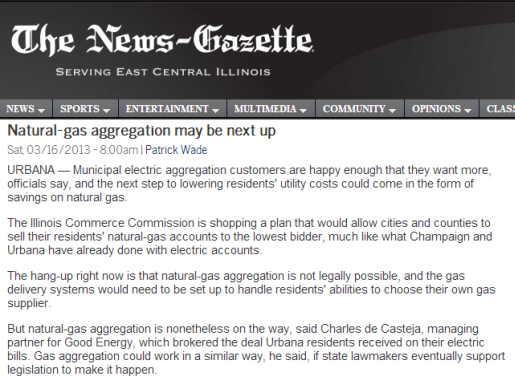
Natural-Gas Aggregation May Be Next Up

Municipal electric aggregation customers have seen real savings since aggregation early last year and the prospect of additional energy savings through natural gas aggregation has people excited. The counties of Champaign and Urbana were among the first to approve referendums allowing electric aggregation. These referendums allowed authorities to contract Good Energy, an electric aggregation consulting firm, to negotiate new rates on their electricity service.

And with the success of electric aggregation, there is a strong push by the Illinois Commerce Commission, with the support of Good Energy, to legalize natural-gas aggregation. The major issue holding gas aggregation up is the fact that it is not currently legal. But, “there’s a groundswell of demand for it,” or so says Charles de Casteja, the managing partner for Good Energy. Given the previous successes Illinois has seen with energy aggregation and the sizeable demand for energy aggregation growth, it seems likely a solution will soon be worked out.

Energy aggregation has lead to tangible savings for the residents of Urbana. They secured a guaranteed rate of 4.05 cents per kilowatt hour through the aggregation initiative. The current rate per kilowatt hour for electricity through Ameren, on the other hand, is 5.45 cents. Mike Monson, the chief of staff to Urbana Mayor Laurel Prussing, summed up the sentiment of residents, “We’ve saved a lot of money. The residents have saved a lot of money.”

Hundreds of other municipalities have voted on similar measures since the beginning of last year. After a vote last November, a second wave of aggregation was negotiated, and after the April ballots, a third wave is scheduled. Given the results of electric aggregation, it is not surprising de Casteja said gas aggregation is a program he believes state lawmakers would be eager to support.

For more information on municipal aggregation, click here. For the full article, see below.

Tuesday
Mar192013

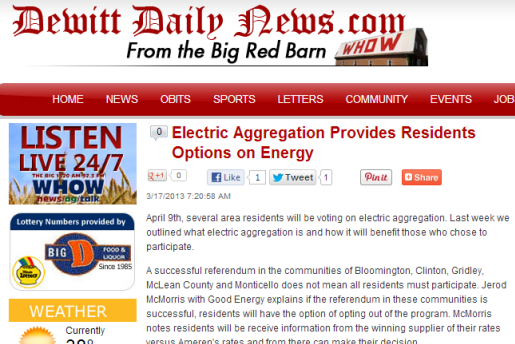
Electric Aggregation Provides Residents Options on Energy

Electric aggregation is on the minds of residents in municipalities all over central and southern Illinois. And for many of them, a vote is coming on April 9 to determine if the residents in those areas will be able to negotiate lower energy rates by banding together to buy electricity through wholesale providers. To facilitate in the process, many municipalities hired Good Energy, an electric aggregation consulting firm.

Should the communities of Bloomington, Clinton, Gridley, McLean County, and Monticello vote yes to their respective aggregation plans, it does not mean that all residents must take part in the change. Every contract allows for an opt out clause, which allows residents to opt out of the aggregation. Good Energy consultant Jerod McMorris explained that residents will be sent an opt out notice from the winning energy provider once the final contract has been signed.

Households which remain in the aggregation will be locked into a guaranteed rate. Rates are guaranteed through the winter and summer, which helps customers to avoid the changing summer and winter rates.

McMorris will be hosting meetings all throughout the area over the coming weeks, discussing the benefits of municipal aggregation. He will be at the Livingston Center in Monticello on Monday at 6 pm. He will be in Clinton on Tuesday at a Rotary club meeting held at the American Legion at noon, then at a Kiwanis Club meeting at 6 pm. On Wednesday, March 27 at noon, McMorris will be in Monticello with the Monticello Rotary Club at the Monticello Library. And his last stop will be to meet with the Young at Heart Group at First Christian Church in Clinton at 10:30 am on April 3.

For more information on municipal aggregation, click here. For the full article, see below.

Tuesday
Mar192013

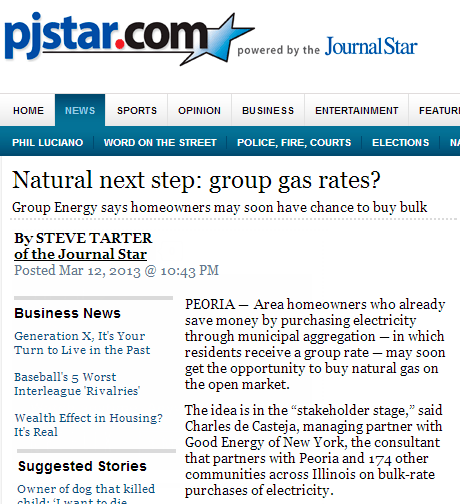
Natural Next Step: Group Gas Rates?

Peoria residents are currently benefiting from the immense cost savings of electric aggregation from their arrangement with Good Energy. According to Good Energy managing partner Charles de Casteja, there is now a chance that they can become eligible for cost savings on gas, as well.

Good Energy CEO Maximilian Hoover is thrilled to be at the forefront of the battle to save residents money in Illinois. Consumers stand to have serious savings from gas aggregation. In Ohio, for instance, residents save anywhere from 5 to 15 percent from aggregation programs. Ohioans have been benefiting from aggregation for almost a decade.

In northern Illinois and Chicago, there have also been options. Ameren customers in southern Illinois have not had the chance to shop for rates between competitors, however ComEd customers have had the choice of “five or six providers,” according to Casteja.

De Casteja says the idea is still in the “stakeholder stage.” Meetings are with stakeholders, including utilities, community representatives, and natural gas suppliers are still necessary. Then, a recommendation must be submitted by the Illinois Commerce Commission to the Illinois attorney general and the Illinois General Assembly.

Still, there is a good chance it will all be approved by 2014, in which case a referendum might be on ballots as early as the April 2014 ballot. In order to benefit from gas aggregation, residents will need to vote on a referendum, just as they did for electric aggregation last year. But according to de Casteja, “This will be very attractive to residents. It won’t be a tough sell.”

For more information on municipal aggregation, click here. For the full article, see below.

Wednesday
Mar062013

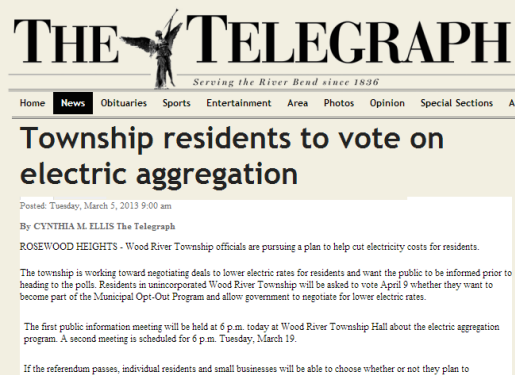
Township Residents to Vote on Electric Aggregation

Good Energy, a municipal aggregation consulting firm, was recently approved by Wood River Township to act as their energy buyer. Good Energy currently represents over 110 communities and over 400,000 households, so hiring them to negotiate their municipal aggregation contract should get residents the best rate available. Residents still must pass a referendum on the April 9 ballot to receive the discounted rate.

Municipal aggregation is the banding together of multiple municipalities and counties in an effort to lower electricity costs. The April referendum, which only applies to unincorporated areas of the township, will grant authorities the right to aggregate for their residents. Madison County had a similar vote in November that failed. The reason for the failure, according to Township Supervisor Mike Babcock, was that voters in eastern Madison County voted no, as the aggregation did not apply to them. Most of those voters belong to electrical co-ops, and aggregation does not apply to members of a co-op. He added that the majority of residents in unincorporated Wood River Township voted yes to the referendum.

"The township voters were in favor of it, so we felt the need to pursue it," Babcock said. "(The township) has received numerous calls from residents during the past months wanting to know why their rates were higher than surrounding communities."

All of the incorporated municipalities in the township have approved aggregation. Good Energy CEO Maximilian Hoover said this referendum stands to help between 1,200 and 1,300 people, and he is excited his company can be a part of that.

This will be the third round of negotiations performed by Good Energy in the past year, and Wood River officials hope to be among the municipalities involved in this round of electric aggregation. Projected savings in this round are between 24 and 27 percent.

For more information on municipal aggregation, click here. For the full article, see below.

Friday
Feb222013

Hoopeston City Approves Good Energy

Good Energy was unanimously approved by the Hoopeston City Council to become the consulting firm to help the city through the municipal aggregation process. Originally thought to be a part of the Vermilion County aggregation referendum passed in April, Mayor Bill Crusinberry and the Hoopeston City Council recently learned that that referendum only applied to unincorporated areas of the county. Because of this, they voted to allow a referendum on the April ballot, allowing Hoopeston to join the rest of the Vermilion County municipalities who have contracted Good Energy.

The goal of Good Energy is to save all residents of the counties and municipalities they work with as much as possible on energy costs. They make this happen with municipal aggregation, which is the process of banding municipalities and counties together to purchase energy at wholesale rates directly from the wholesale energy companies. When compared to the contract submitted by Vermilion County, the decision to sign the Good Energy contract was easy.

Jerod McMorris, the Good Energy consultant working with Hoopeston, is excited to start educating residents on what electric aggregation is and how it helps to lower monthly electric bills. To help get him started, McMorris asked the council to aid him in setting up meetings with local organizations, a town hall meeting, and has requested to place an ad on a billboard. This will be the beginning of the education process about the many benefits of aggregation. McMorris expects that residents will approve the referendum in April, as long as they understand exactly how aggregation works.

For more information on municipal aggregation, click here. For the full article, see below.